 By Rude Boy
The PVS59 Pre-Visualization Scope has finally arrived to solve one of the great unresolved problems of contemporary image-making: apparently, looking at something and deciding how to photograph it was not complicated enough. Designed for artists, photographers, cinematographers and other people who have somehow managed to avoid the comforting simplicity of just looking through a camera, the PVS59 is a high-fidelity pre-visualization instrument that allows the operator to determine, with extraordinary precision, what an image might look like before actually making the image. And when I say extraordinary precision, I mean that this thing has enough knobs, scales, switches, reference marks and technical specifications to make the average camera look like a disposable Kodak.

The PVS59 does not take photographs. This is perhaps its most important feature. It has no shutter, no recording medium, no memory card, no sensor capable of producing an image and, as far as we can tell, no particular interest in photography itself. Its sole purpose is to help you decide what you might want to photograph later with an entirely different device. In other words, it is a highly sophisticated optical instrument whose principal function is to look at things so that another optical instrument can eventually look at the same things. This is progress.
Naturally, such an important task requires serious engineering. The PVS59 is constructed from magnesium alloy, anodized aluminum and stainless steel, finished in Mil-Spec Type III hard-anodized black. This is reassuring because nothing says “I am considering whether the horizon should be three degrees higher” quite like military-grade surface treatment. The machine weighs 2.35 kilograms, which is roughly the weight of a small house cat, although the cat probably has fewer controls and is significantly less likely to require an exploded-view diagram before use.
And what a control panel it has. There is a variable aperture from f/1.4 to f/16, because naturally one must be able to pre-visualize the effects of aperture before setting the aperture on the actual camera. There is a focus and distance scale, a parallax adjustment, depth preview, focal-length reference, exposure compensation, color-temperature control, brightness control, frame-line selection, grid control and a focus-assist system offering both PEAK and EDGE modes. There are display modes A, B and A/B. There is a calibrated field-of-view scale. There is an image-circle reference. There is even a dedicated control for depth preview, allowing you to preview the depth of field you will later produce with another lens on another camera. If this seems unnecessarily elaborate, please understand that we are dealing with professionals.

The PVS59 is particularly useful for those rare moments when a photographer has looked through a perfectly serviceable viewfinder and thought, “I can see the picture, but I don’t feel sufficiently involved in the process.” The PVS59 solves that problem by placing an entire optical bureaucracy between the artist and the photograph. Instead of simply looking, you now configure. You calibrate. You reference. You adjust. You verify. You consult the scale. You reconsider. You make another adjustment. Eventually, you look through the thing and discover that the picture you were thinking about isn’t very good. But at least you have determined that scientifically.
This is where the PVS59 becomes truly profound. It is actually more complicated than the cameras that will be used to capture what it pre-visualizes. That is the central joke and, perhaps, the central criticism. The instrument that merely helps you decide what the photograph should be is more elaborate than the instrument that actually makes the photograph. The PVS59 has become the photographic equivalent of constructing an air-traffic-control tower so you can decide where to park your bicycle. It is a triumph of engineering applied to a problem that was previously solved by eyesight, experience and a little imagination.
Of course, this is not entirely unfamiliar territory. Photography has spent decades developing technology that removes difficulty from the act of making pictures while simultaneously inventing new difficulties to replace it. Autofocus eliminated the need to focus manually, so we invented autofocus modes. Automatic exposure eliminated the need to calculate exposure, so we invented exposure compensation. Digital photography eliminated the cost of film, so we began taking thousands of photographs. Cameras learned to recognize faces, eyes, animals and objects, and then we began debating which autofocus algorithm was best at recognizing the eyes of a bird flying through a forest at night. At some point the machinery became so intelligent that the photographer’s principal creative responsibility became navigating the menu system.

The PVS59 takes this tendency to its logical conclusion. It does not make the photograph easier. It makes thinking about making the photograph harder. And that is precisely why it is so funny.
There is something wonderfully bureaucratic about the whole machine. The technical drawing looks less like documentation for a photographic accessory and more like the classified blueprint for an experimental aircraft. Every knob has a number. Every surface has a callout. There are optical-path diagrams, material specifications, environmental operating ranges, mounting interfaces, axis references, power-input diagrams, exploded views and certifications. One expects to find a small paragraph somewhere explaining what to do if the PVS59 loses hydraulic pressure at 30,000 feet.
The specification sheet even tells us the operating temperature range and shock-and-vibration standard. This is excellent news for the cinematographer who has been wondering whether the composition of a coffee shop scene can be safely pre-visualized at altitude. Apparently it can. The PVS59 will survive. The artistic concept may not, but the PVS59 will.
Perhaps the most beautiful part of the machine is its seriousness. It doesn’t wink at you. It doesn’t acknowledge the absurdity. It presents itself with the absolute confidence of a piece of equipment that has been designed for a task of enormous consequence. And that makes the joke better. It is the visual equivalent of wearing a tuxedo to mow the lawn. The machine takes the simple human act of looking at something and deciding that it might make a good picture and wraps that act in the language of aerospace engineering.
There is, however, a genuine idea hiding underneath all this glorious nonsense. Pre-visualization is real. Thinking before shooting is real. Understanding focal length, perspective, depth of field, framing, parallax, exposure and color is real. A serious photographer or cinematographer absolutely should be able to imagine the resulting image before pressing the shutter. The PVS59 simply asks the question: how much machinery do we really need between the human imagination and that act of seeing?

The answer, apparently, is 2.35 kilograms of magnesium alloy, a Mil-Spec finish, an interchangeable lens interface, a parallax system, calibrated frame lines, depth preview, exposure compensation, color temperature control, focus assist, a field-of-view scale and enough knobs to make NASA nervous.
The PVS59 is therefore more than a fictional piece of absurd photographic equipment. It is a monument to overthinking. It is a mechanical manifestation of the idea that if something is worth doing, it is probably worth adding a control knob to it. It is what happens when the simple act of seeing becomes sufficiently professionalized that somebody decides seeing requires an instrument.
And maybe that’s the real beauty of it. The PVS59 doesn’t take the picture. It doesn’t need to. It has already accomplished something much more difficult: it has transformed looking into an engineering discipline.
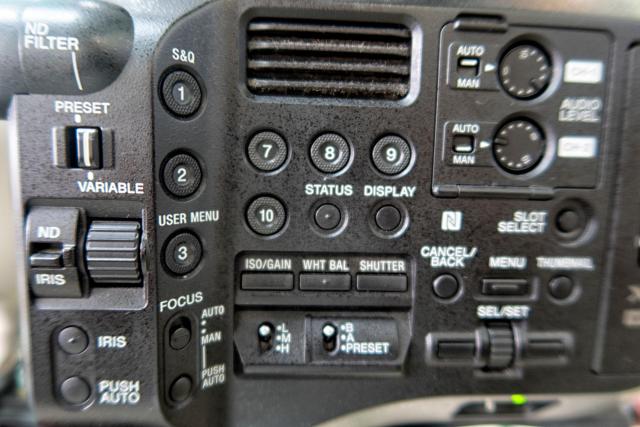
It is a pre-visualizer for the pre-visualizer.
A bureaucratic middleman between the artist and the image.
A command-and-control center for deciding whether the subject should be moved six inches to the left.
A machine for the photographer who looks at a Leica and says, with complete sincerity, “Beautiful camera. But where are all the knobs?”
The PVS59 is proof that photography has finally reached the point where we can spend more time preparing to make a picture than actually making one.
And frankly, that is exactly the kind of progress we deserve.

Discover more from Eric Hatheway
Subscribe to get the latest posts sent to your email.